
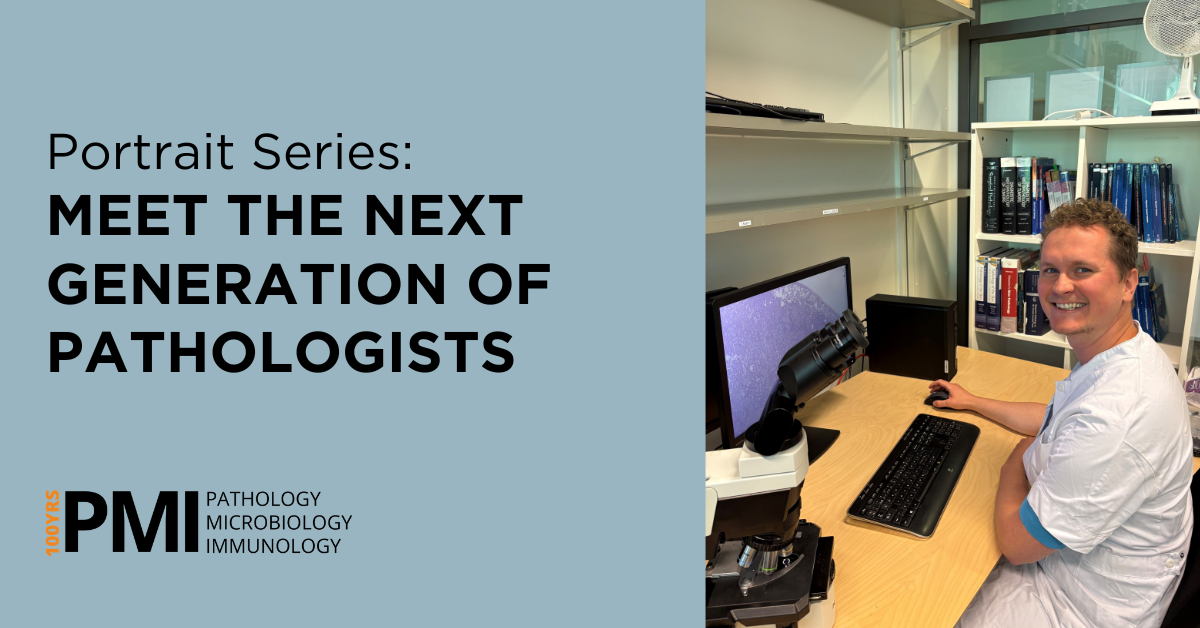
Martin Stampe is a 30-year-old Danish medical doctor and PhD student at the University of Copenhagen and the Department of Pathology, Rigshospitalet. His research focuses on digital pathology, particularly how artificial intelligence can enhance and support routine microscopy in lung cancer diagnostics.
What is your (latest) PMI article about in layman’s terms?
In the article we have investigated how reliably an artificial intelligence solution of our own design can classify different categories of cell types in hematoxylin and eosin-stained whole slide images of lung cancer as seen under the microscope. We are initially interested in how accurately the technology can recognize cancer cells and separate them from non-cancer cells. The field of digital pathology is still relatively new and there is currently a significant scientific and political interest in uncovering the use cases for new technology like artificial intelligence.
Read the study here
Why did you become a researcher?
Hearing researchers present their findings has always inspired me. However, I initially found it daunting to get into research, as I did not know where to begin. When I had to write my master’s thesis at the university, I was fortunate to be given the chance to conduct my own research project within the field of pulmonary pathology. From then on it did not take long for me to recognize how fascinating, motivating and great fun the world of pathology and research is. Research is a great way to foster creativity, and in my experience, there are usually a few surprises along the way. Immersing myself in the world of research has opened many doors and has put me into contact with numerous brilliant and enthusiastic people. For that, I am exceedingly grateful.
Who inspires you academically?
I have been very inspired by the technological advances in cell nuclei segmentation and classification precipitated by the work of Simon Graham and his colleagues.
What research are you reading right now for inspiration?
I recently read a systematic review and meta-analysis by Rafael Parra-Medina et al. The article summarizes the literature on advances in deep learning models’ ability to predict oncogenic driver molecular alterations in non-small cell lung cancer in hematoxylin and eosin-stained whole slide images.
What are your scientific aspirations?
I hope to contribute significantly to bridge the gap between conventional pathology and the digital age. There is currently a myriad of unanswered questions regarding the applications and uses for artificial intelligence solutions in pathology that need to be investigated and answered before artificial intelligence can be safely utilized in routine diagnostics. While artificial intelligence holds potential and certainly comes with no small amounts of hype, it is still not clear exactly what these solutions can offer in the daily work routine.
Why did you choose PMI?
It was appealing to me, that the journal encompasses research from multiple paraclinical disciplines and that the journal welcomes early-career researchers. While I am primarily occupied with the field of pathology, I think it is both wise and necessary to pay attention to advances in other fields as well. This provides an opportunity to learn valuable lessons from each other across the span of different scientific research fields.
At PMI, we are committed to supporting early-career researchers in pathology, microbiology, and immunology. You can visit our young researchers’ universe HERE.
Find more information about publishing opportunities and our author guidelines HERE. Feel free to contact us if you have any questions or wish to discuss a potential submission – we’re happy to hear from you!